x402: Can HTTP 402 Power Payments for AI Agents?
An open-source protocol is trying to give the internet a native payment layer for both humans and machines. Here's how it works, who's building on it, and what could go wrong.
The 30-Year Wait for HTTP 402
Every developer knows 200 OK, 404 Not Found, and 500 Internal Server Error. But there's one status code hiding in the HTTP spec since 1997 that almost nobody has used: 402 Payment Required.
The original RFC said: "This code is reserved for future use." The people who designed HTTP knew the web would eventually need a built-in way to pay for things. They just couldn't build it yet because there was no digital money that was fast, cheap, and programmable enough.
So what happened instead? Credit cards, Stripe, PayPal. All built on top of HTTP using forms, redirects, and 3-day settlement.
They worked fine for humans. But they're useless for AI agents that can't fill out forms or pass KYC.
Three things changed:
- Stablecoins got good. USDC on modern chains like Base and Solana can confirm within seconds under normal network conditions, with very low transaction costs.
- L2 chains got fast. Base does ~2 second confirmations. Solana does ~400ms.
- AI agents showed up. Agents don't get decision fatigue from micropayments. They just need a wallet and a way to sign transactions. But they can't use credit cards.
Cloudflare has noted that automated traffic hits paywalled endpoints at massive scale, often returning HTTP 402 responses. These are regular HTTP 402 status codes, not x402 protocol transactions.
But they show the scale of the problem: machines are already hitting paywalls constantly, and there's no standard way for them to actually pay.
What Is x402?
x402 is an open-source protocol from Coinbase that tries to put HTTP 402 to work. It is not part of the official HTTP standard, but a protocol layered on top of status code 402.
It defines a standard way for servers to say "pay me" and clients to say "here's the money", all inside regular HTTP headers.
No traditional platform accounts. No API keys. No human needed.
The "x" means experimental, like X- headers. Here is where the protocol stands today:
- Launched in May 2025 by Coinbase.
- The V2 release shipped in December 2025 with multi-chain support and a modular SDK.
- The x402 Foundation went operational under the Linux Foundation on 14 July 2026, with 40 founding members. Premier members include AWS, Google, Stripe, Visa, Mastercard, American Express, Shopify, Cloudflare, Circle, Coinbase, Adyen, Fiserv and Ripple.
- The big platforms shipped during 2026. Stripe on 10 February, AWS in May, Cloudflare's Monetization Gateway on 1 July.
- Security research caught up too, and it wasn't kind. That section is near the end and it's the one to read before you put real money through this.
That member list is the part worth pausing on. This isn't a crypto consortium. It's the companies that own the existing payment rails, standardising a way around their own rails.
How It Works (The Actual HTTP Flow)
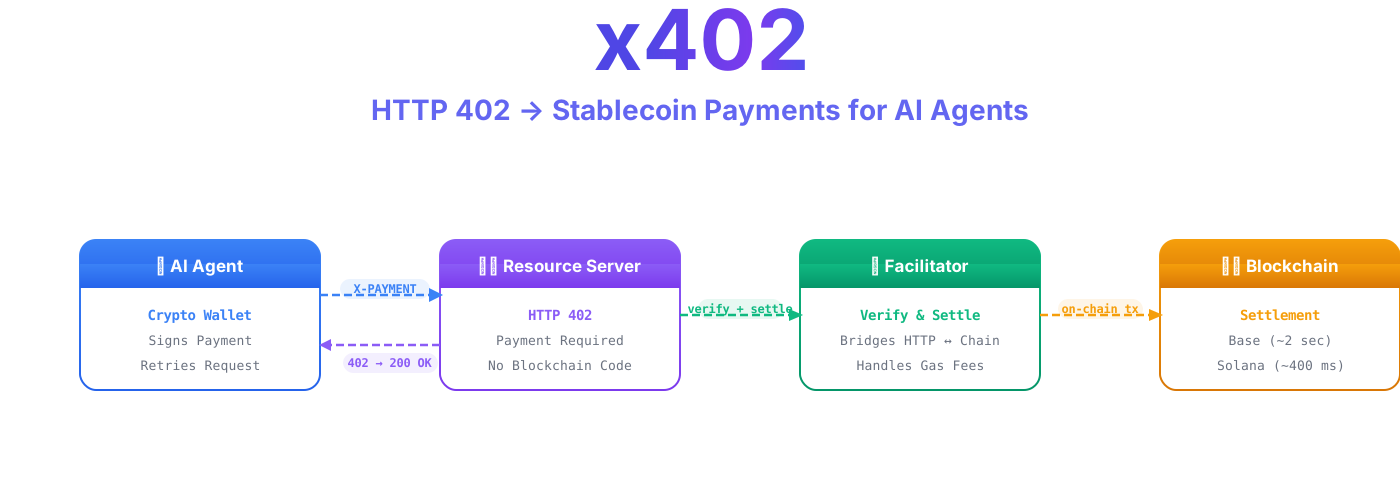
In the simplest case, it's a two-request flow. Here's what happens when an OpenClaw agent tries to access a paid weather API:
1. Agent requests data, gets a 402 back
curl -i https://api.example-weather.xx/forecast?city=bangaloreHTTP/1.1 402 Payment Required
Content-Type: application/json
{
"x402Version": 2,
"accepts": [{
"scheme": "exact",
"network": "eip155:8453",
"maxAmountRequired": "100000",
"payTo": "0xRecipient...abc",
"description": "Weather forecast, Bangalore",
"extra": { "name": "USDC", "version": "2" }
}]
}The server is saying: "This costs $0.10 in USDC on Base. Here's where to send it."
2. Agent signs the payment and retries
The agent's wallet signs an EIP-3009 authorization (a gasless USDC transfer), then sends the same request again with the payment attached:
curl -i \
  -H "X-PAYMENT: eyJwYXlsb2FkIjp7InNpZ25hdHV..." \
  https://api.example-weather.xx/forecast?city=bangalore
HTTP/1.1 200 OK
X-PAYMENT-RESPONSE: eyJ0eEhhc2giOiIweGFiYy4uLiJ9
{
"city": "Bangalore",
"forecast": "Partly cloudy, 32°C, humidity 78%",
"next_3_days": [...]
}That's it. The facilitator verified the payment, settled it on-chain, and the server returned the data. Under normal network conditions, the whole thing takes about 2 seconds.
The Four Players
| Who | What They Do |
|---|---|
| Client | Requests data, signs payments. Can be a browser, app, or AI agent. |
| Resource Server | Your API. Returns 402 when payment is needed. Does not interact with the blockchain directly in the default facilitator model. |
| Facilitator | The bridge between HTTP and blockchain. Verifies signatures, submits transactions, handles gas. Coinbase runs one for free (1,000 tx/month). |
| Blockchain | Where the money actually moves. Base or Solana. |
The key design choice: your server doesn't need to talk to the blockchain directly. You don't need to run a node or write smart contracts. The facilitator does all of that.
Building With x402
Selling: Add Payments to Your API (Express)
import express from "express";
import { paymentMiddleware } from "@x402/express";

const app = express();

// paymentMiddleware handles 402 response + verification + settlement
app.use(paymentMiddleware({
  "GET /forecast": {
    price: "$0.10",
    network: "base",
    description: "Weather forecast",
  },
}));

app.get("/forecast", (req, res) => {
  res.json({ city: "Bangalore", forecast: "Partly cloudy, 32°C" });
});

app.listen(4021);
One middleware call. Every unauthenticated request to /forecast gets a 402 with payment instructions. The middleware handles verification and settlement automatically.
Selling: Next.js Middleware (Vercel)
import { paymentMiddleware } from "@x402/next";

export default paymentMiddleware({
  "/api/forecast": {
    price: "$0.05",
    network: "base",
    description: "Weather API",
  },
});
Buying: Make Paid Requests (TypeScript)
import { x402Client, wrapFetchWithPayment } from "@x402/fetch";
import { registerExactEvmScheme } from "@x402/evm/exact/client";
import { privateKeyToAccount } from "viem/accounts";

const signer = privateKeyToAccount(process.env.PRIVATE_KEY!);
const client = new x402Client();
registerExactEvmScheme(client, { signer });

const fetchWithPay = wrapFetchWithPayment(fetch, client);

// This handles 402 -> sign -> retry automatically
const res = await fetchWithPay("https://api.example-weather.xx/forecast?city=bangalore");
console.log(await res.json());
Buying: Python
import asyncio, os
from eth_account import Account
from x402 import x402Client
from x402.http.clients import x402HttpxClient
from x402.mechanisms.evm import EthAccountSigner
from x402.mechanisms.evm.exact.register import register_exact_evm_client

async def main():
    client = x402Client()
    account = Account.from_key(os.getenv("PRIVATE_KEY"))
    register_exact_evm_client(client, EthAccountSigner(account))

    async with x402HttpxClient(client) as http:
        resp = await http.get("https://api.example-weather.xx/forecast?city=bangalore")
        print(resp.json())

asyncio.run(main())
Install
# TypeScript
npm install @x402/fetch @x402/evm       # client
npm install @x402/express @x402/evm      # server (Express)
npm install @x402/next @x402/evm         # server (Next.js)

# Python
pip install "x402[httpx]"               # async
pip install "x402[requests]"            # sync
How OpenClaw Agents Use x402
This is where it gets interesting, at least in theory. OpenClaw agents are autonomous. They run on a device, connect to messaging platforms, and act on behalf of the user.
x402 could give them the ability to spend money without asking every time.
Example: Agent-to-Agent Restaurant Booking
Say a personal travel agent is built on OpenClaw. A user tells it: "Book me a table for two at a nice Italian place in Bangalore tonight."
The agent doesn't know Bangalore restaurants. But there's another agent running a restaurant discovery API, charging $0.05 per search via x402. And a third agent running a booking service at $0.20 per reservation.
Here's what happens without any human involvement:
- The travel agent calls the restaurant discovery API
- Gets back a 402: "Search costs $0.05 in USDC"
- The agent checks its spending policy, signs the payment, retries
- Gets a list of Italian restaurants with availability
- Picks the best match, calls the booking agent's API
- Gets another 402: "Booking costs $0.20 in USDC"
- Signs, pays, gets a confirmed reservation
- Sends the user a confirmation on WhatsApp
Three agents, two payments, zero human approvals. Each agent is just an API behind an x402 paywall. They don't need to know each other, share API keys, or have accounts with each other.
The wallet is the identity and the payment is the authentication.
This is the pattern x402 is designed for. Any agent can sell a capability as a paid endpoint. Any other agent can discover it and pay for it on the spot.
Whether this actually works reliably in practice is still being figured out.
MCP + x402: Paid Tool Discovery
OpenClaw has native MCP support. When MCP servers expose paid tools via x402, an agent can discover and pay for them automatically:
import { withPayment } from "x402-mcp";
import { experimental_createMCPClient as createMCPClient } from "ai";

const url = "https://example-mcp-server.xx";
const mcpClient = await createMCPClient({
  transport: new StreamableHTTPClientTransport(url),
}).then((client) => withPayment(client, { account }));

// Agent discovers paid tools and pays automatically
const tools = await mcpClient.tools();
Cloudflare and Vercel both ship x402-MCP integrations, and a growing number of MCP servers support x402 payments.
How Agents Actually Pay, Step by Step
Traditional payments need a human, someone who types a card number and clicks "Pay." Agents can't do that. Here's how x402 solves it:
Wallet setup. Every agent gets a blockchain wallet (public/private key pair). Fund it with USDC, and the agent controls its own key.
Gasless signing. The agent never needs ETH or SOL for gas. It just signs an EIP-3009 authorization message saying "I authorize transferring X USDC from my wallet to this address." The facilitator submits the actual transaction and pays the gas.
Spending policies. Good agents don't blindly pay every 402 they see. They check:
- Is this within my per-transaction limit?
- Am I under my daily budget?
- Is this domain whitelisted?
- Is this data actually useful for my current task?
Finality. Once settled, it's done, with no chargebacks, no disputes, no 3-day wait. The agent gets a transaction hash as receipt.
x402 vs Traditional Payments
| Stripe / Cards | x402 | |
|---|---|---|
| Settlement | 1-3 business days | ~2 seconds (Base, normal conditions) |
| Minimum payment | ~$0.50 (fees kill micropayments) | Very small amounts impractical on card networks |
| Account needed | Yes | No |
| Works for AI agents | No | Yes |
| Chargebacks | Yes | No, blockchain finality |
| Fees | 2.9% + $0.30 | Near-zero (gas only) |
| Integration | SDK + webhooks + dashboard | One middleware function |
Who's Involved (And How)
Not all involvement is equal. Some companies built production integrations, others are just exploring.
| Company | Involvement | Status |
|---|---|---|
| Coinbase | Created the protocol. Runs the primary facilitator (1,000 free tx/month). | Production |
| Cloudflare | x402 in Workers and the Agents SDK. Monetization Gateway (1 Jul 2026) and Cloudflare Wallets (Aug 2026). | Production |
| Stripe | Shipped x402 support on 10 Feb 2026 as a preview product called Machine Payments, using USDC on Base. | Production |
| AWS | Bedrock AgentCore Payments, preview from May 2026. Agents make x402 payments with wallet management and spending controls built in. | Preview |
| Vercel | x402-next middleware, x402-fetch client, x402-mcp for paid MCP tools. | Production |
| Browserbase | AI agents pay per browser session via x402. No signup needed. | Production |
| Built a separate protocol (AP2) that is payment-agnostic and could interoperate with crypto-based protocols like x402. Also a premier member of the x402 Foundation. | Complementary | |
| Visa | Has its own Trusted Agent Protocol (TAP), and is a premier member of the x402 Foundation. | Both |
Cloudflare Built Both Ends of It
Cloudflare is worth its own section, because during 2026 it shipped the seller side and the buyer side within a month of each other.
The Monetization Gateway (waitlist opened 1 July 2026) lets you charge for anything already sitting behind Cloudflare. Web pages, datasets, APIs, MCP tools. You write a rule in the dashboard or in Terraform, set a price, and the edge does the rest.
Two details matter. Verification happens at the edge, so your origin never sees an unpaid request. And in Cloudflare's words, "settlement happens peer-to-peer, so any funds that a buyer sends to a seller are directly deposited to the seller's wallet."
There's no merchant account in that sentence. That's the whole point.
Cloudflare Wallets launched in August 2026 and is the other half. It splits into two kinds:
- Account Wallets are held by a human, who funds them and sets the rules.
- Virtual Wallets are operated by an API key and handed to one agent, under limits the owner set.
The guardrails are an allowance, an allow list, and a maximum transaction size. Cloudflare's own example is giving every employee a $100 per week budget for AI inference.
Alongside it came cloudflare.pay handles, which are readable names for agents. Something like research.example.cloudflare.pay. Cloudflare describes it as "a human-readable identifier for a not-very-readable keypair, similar to the URL and IP-address pairings used in DNS."
If that sounds like they're rebuilding DNS for wallets, that's because they are.
The Stablecoin Layer Is Changing Underneath
x402 needs a stablecoin to settle in, and that layer moved in 2026 too.
Open USD launched from a company called Open Standard. Behind it is a coalition of 200+ organisations, including Stripe, Shopify, BlackRock, Mastercard, Visa, Coinbase, Solana and Polygon.
The interesting part isn't the peg. Every fiat-backed stablecoin holds reserves and redeems at a dollar, and Open USD is no different there.
The interesting part is who keeps the interest.
A stablecoin issuer holds billions of dollars of reserves and earns interest on them. Traditionally the issuer keeps that. Open USD's pitch is "nearly all reserve economics shared with companies that grow adoption", plus "no fees to mint or redeem, even at scale".
So the money that used to be the issuer's margin gets paid to whoever brings the volume. Which tells you where the competition has moved. Not to the mechanism, which everyone solved years ago, but to distribution.
For x402 this matters in a plain way. If you're a platform routing millions of agent payments, the stablecoin you settle in is now a revenue decision rather than a technical one.
What V2 Changed (December 2025)
- Multi-chain via CAIP-2. Universal chain identifiers.
eip155:8453for Base,solana:5eykt4U...for Solana. Any chain can be added. - Wallet-based identity. Servers recognize returning wallets. Pay once, access for a duration instead of re-paying on every call.
- Deferred payments. Settle later instead of immediately. Enables post-pay models.
- Dynamic recipients. Server picks the recipient at request time. Enables marketplace routing.
- Traditional rails. The design allows traditional rails like ACH or cards to be integrated through the same 402 negotiation flow.
- Modular SDK. Add new chains, facilitators, or payment schemes without changing the core protocol.
Sequence Diagram
x402 Is Not the Only Option
x402 is one of the more visible crypto-native micropayment protocols today, but it's not the only one trying to solve agent payments. The landscape is actively fragmenting:
| Protocol | Backed By | Approach |
|---|---|---|
| x402 | Coinbase, Cloudflare | Crypto-native, HTTP-level, stablecoin micropayments |
| ACP (Agentic Commerce Protocol) | OpenAI, Stripe | Fiat-focused, already live in ChatGPT for Etsy sellers |
| AP2 (Agent Payments Protocol) | Google, 60+ partners | Payment-agnostic, supports PayPal, Amex, and x402 |
| Visa TAP | Visa | Leverages existing card network for agent payments |
| Mastercard Agent Pay | Mastercard | Mastercard's equivalent for AI agents |
No single protocol is likely to win everything. Each one fits a different job:
- x402 makes the most sense for stablecoin micropayments between autonomous agents.
- ACP has stronger traction in traditional e-commerce.
- AP2 has the broadest institutional coalition.
If you're building something, it's worth understanding all of them.
Is Anyone Actually Using It?
This is the section most write-ups skip, and it's the one that should decide whether you build on this today.
The headline numbers look enormous. By late April 2026 Coinbase reported 69,000 active agents, 165 million transactions, and around $50 million in cumulative volume.
Then look at what a transaction is worth. $50 million across 165 million transactions is about 30 cents each.
Now the harder number. In March 2026 the analytics firm Artemis measured $28,000 of daily volume across roughly 131,000 daily transactions, an average of about $0.20. Their verdict was blunt: "The x402 'agent payments' boom is still mostly a mirage."
Their reasoning was that roughly half of it isn't commerce at all. They named two patterns:
- Self-dealing, "where the same wallet acts as both buyer and seller".
- Wash trading, "where the seller funds the buyer's wallet, which then sends the money back".
So the count is real and the dollars are not. 131,000 transactions a day sounds like an economy. $28,000 a day is one mid-sized SaaS account.
The reason isn't the protocol. It's that the merchants don't exist yet. x402 is built for pay-per-use APIs priced in fractions of a cent, and almost nobody sells anything that way, because until now nobody could.
Which is the honest summary: the infrastructure arrived before the economy it was built for.
That's not a reason to ignore it. Rails usually do arrive first. It is a reason to be careful about anyone quoting the transaction count at you without quoting the dollar volume next to it.
Things to Know Before You Build
No refunds by default. Blockchain finality means the payment is permanent. If you need refund logic, you have to build it yourself.
USDT doesn't work. Current EVM implementations of x402 rely on EIP-3009-style authorizations for gasless USDC transfers. USDC supports it, USDT doesn't.
So the biggest stablecoin by market cap is currently excluded.
The security picture got worse, not better. This post originally said there was no formal audit yet. There is now published research, and the findings are the reason to slow down.
A 2026 paper, Five Attacks on x402 Agentic Payment Protocol (arXiv 2605.11781), reports five practical attacks. They sit in authorization, binding, replay protection and web-layer handling.
The authors validated all five on local chains, on Base Sepolia, and against live endpoints. They audited three open-source SDKs along the way.
The two outcomes they describe are worth memorising, because they're the only two that matter here:
- Unpaid service. The client gets the resource without the payment settling.
- Paid but denied. The client's money moves and the resource never arrives.
Both are already possible in real deployments, not just in theory.
Separately, a signature verification bypass was disclosed in the x402 SDK on 7 March 2026 (GHSA-qr2g-p6q7-w82m). A signature bypass in a payment protocol is about as bad as the category gets.
And the Foundation launched without a conformance suite, a security profile, or a validation procedure. So there's a standards body and 40 members, and still no agreed way to test whether an implementation is correct.
None of this makes the design wrong. It makes the implementations young. Treat any SDK here the way you'd treat a payments library at version 0.x, because that's what it is.
Facilitator concentration. Much of the current ecosystem relies on Coinbase's facilitator. If it goes down, there's no automatic fallback.
Open-source alternatives exist but aren't well-tested yet.
Extra latency. The 402 round-trip adds ~2 seconds under normal network conditions. For latency-sensitive use cases, wallet-based identity (V2) helps by caching auth.
Regulatory gray area. Autonomous cross-border micropayments don't fit neatly into existing financial regulations. KYC/AML compliance falls on the service providers, not the protocol.
OpenClaw is still in beta. It's powerful but young. OpenClaw agents run with elevated permissions: shell access, file system access, network access.
When you add x402 payment capabilities on top of that, you're giving an agent with broad system access the ability to spend real money.
Security audits have flagged numerous vulnerabilities, including critical ones. A recently disclosed remote code execution vulnerability was later patched. The ClawHub skill marketplace has also had incidents with malicious skills.
If you're experimenting with OpenClaw + x402, four rules. Keep wallet balances small. Use spending caps. Whitelist trusted endpoints. And don't run it on a machine holding anything sensitive.
The Takeaway
For 30 years, HTTP 402 was a placeholder. The technology wasn't ready. No fast money, no cheap chains, no machine clients.
All three showed up at once. x402 fills the gap with a design you can hold in your head: server says "pay me", client signs a payment, facilitator settles it on-chain.
What changed in 2026 is who's carrying it. AWS, Google, Stripe, Visa, Mastercard, Amex and Shopify are all premier members of the Foundation now.
These are the companies that own the rails x402 routes around. Read that as a strong signal or as a hedge, depending on how cynical you are.
What hasn't changed is the substance. Published research found five practical attacks. There's no conformance suite. The daily volume is $28,000 and about half of it is wallets paying themselves.
So the honest position is that the rail is real and the economy on top of it isn't there yet. That's a normal order for infrastructure. Learn it now, and keep the balance small.
Resources: