QUIC and WebTransport: Rebuilding the Internet for the Real World
TCP, HTTP/1.1, and SIP were built for desktops on reliable networks. Mobile devices, 5G, real-time gaming, and large-scale cloud applications have different requirements, and these older protocols don't meet them.
QUIC and WebTransport rethink internet protocols for how we actually use the internet now.
🚀 QUIC: Reinventing the Transport Layer
Google built QUIC (Quick UDP Internet Connections) because TCP had become the bottleneck for its services.
Historical Context
QUIC was initially developed by Google in 2012, with the first public deployment in Chrome 29 (2013). After proving its value at scale, Google proposed it to the IETF for standardization in 2015.
The IETF QUIC Working Group was formed and refined the protocol. It published RFC 9000 (QUIC transport) in May 2021, alongside RFC 9001 (QUIC TLS) and RFC 9002 (QUIC recovery).
TCP's Problem
| Problem | Why it matters today |
|---|---|
| 3-step handshakes | Slow startup, painful on high-latency networks. |
| Head-of-Line blocking | One delayed packet stalls the entire connection. |
| Breaks on IP change | If you switch networks (WiFi ➔ 5G), connection drops. |
| Optional encryption | Security is added on top, not built in. |
| OS kernel integration | Protocol improvements require OS updates. |
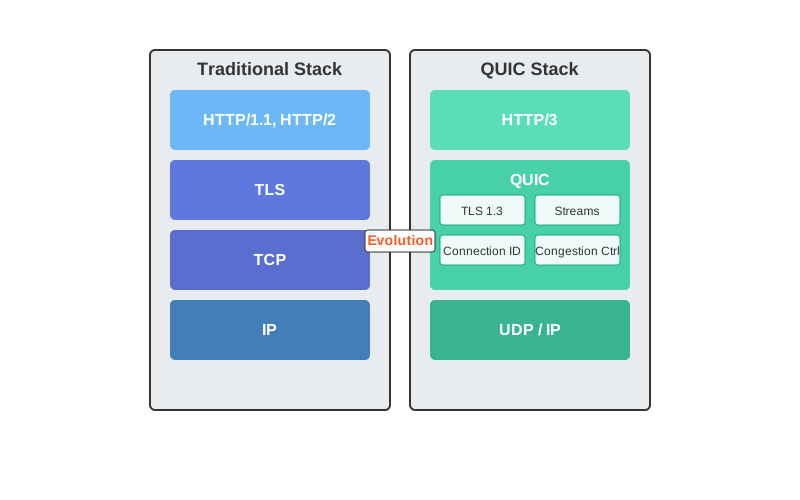
QUIC was designed as a new protocol to fix these, by using a different base: UDP, not TCP.
✅ QUIC builds its own reliability, ordering, encryption, and recovery directly on top of UDP.
🛠️ How QUIC Works Internally
🔹 1. Connection Establishment (Handshake)
- 1-RTT or 0-RTT handshake:
- Resume prior connections instantly.
- First-time connections take only 1-RTT to establish encryption and start sending data.
- Result: Connect faster than traditional TCP + TLS setups.
Technical note: QUIC combines transport and cryptographic handshakes into a single step. In 0-RTT resumption, clients can send application data immediately using previously derived keys, significantly reducing latency for repeat visitors.
🔹 2. Multiplexed Streams
- Many independent streams inside one QUIC connection.
- Delay/loss in one stream does not block others.
- Result: No application-layer head-of-line blocking.
Technical implementation: Each stream has its own flow control and ordering, with a unique stream ID. Bidirectional streams use even IDs initiated by clients and odd IDs from servers, while unidirectional streams follow a separate numbering pattern.
🔹 3. Reliability and Congestion Control
- QUIC reimplements TCP-like reliability itself.
- Congestion control algorithms evolve faster (user-space innovation).
- Result: Smarter, tunable transport.
Technical note: QUIC uses acknowledgment ranges and timestamps for precise packet loss and delay detection. The default congestion control algorithm is CUBIC (like modern TCP), but implementations can easily swap in alternatives like BBR without OS updates.
🔹 4. Connection Migration
- Connections are identified by Connection IDs, not just IP addresses.
- Transitions across networks (WiFi ➔ 5G) without dropping the connection.
- Result: True mobility resilience.
Implementation detail: Clients generate and control Connection IDs, allowing them to switch networks while maintaining the same logical connection. Servers can issue preferred Connection IDs for load balancing purposes.
📊 Why This Matters
| TCP was designed for... | QUIC is designed for... |
|---|---|
| Static devices (desktops) | Mobile, dynamic networks |
| Stable connections | Frequent network changes |
| Slow, reliable links | Flaky, high-speed wireless |
| Minimal encryption | Mandatory encryption (TLS 1.3) |
| Protocol ossification | Rapid protocol evolution |
TCP is a truck on a paved road. QUIC is a high-speed hovercraft for rough and unstable terrain.
🌐 Who Is Using QUIC Today?
QUIC is already deployed at massive scale:
- Google: Search, YouTube, Gmail, Google Meet all use QUIC (and HTTP/3).
- Meta: Facebook, Instagram, and WhatsApp use QUIC for performance.
- Cloudflare: QUIC support across its CDN and security services.
- Microsoft: QUIC inside Edge, Teams optimizing calls.
- Amazon: Gradually adopting QUIC across AWS services and Prime Video.
- Apple: QUIC support inside Safari and iCloud gradually increasing.
Google Meet:
Google Meet uses QUIC for its internal media transport to deliver smoother video and audio. It does not rely on SIP.
Instead of traditional SIP + RTP, Google Meet uses custom signaling over HTTPS (or WebRTC) and increasingly uses QUIC internally for the media plane, meaning faster reconnections, better handling of network changes, and low-latency encrypted streams.
Bottom line: Real-time communication is already moving to QUIC, without SIP dependency.
Browser Support
All major browsers support HTTP/3 over QUIC:
- Chrome/Edge: Since version 85 (2020)
- Firefox: Since version 88 (2021)
- Safari: Since version 14 (2020)
- Mobile browsers: Widely supported
🌐 Moving Higher: WebTransport and the Future of Real-Time Communication
Historically, developers built on:
| Need | Protocol | Problems |
|---|---|---|
| Real-time chat/gaming | WebSocket | TCP-based, head-of-line blocking. |
| Server updates | SSE | One-way only, fragile on mobile. |
| Low-latency media | WebRTC | Complex setup, NAT traversal issues. |
WebTransport brings:
- Multiplexed bidirectional streams inside a QUIC connection.
- Reliable or unreliable delivery depending on need.
- Built-in encryption.
- Low latency.
- Mobile resilience (connection migration).
- Simpler API than WebRTC.
- Easier server-side implementations.
No more bending TCP-based solutions. WebTransport is built for real-time applications from day one.
🧐 Special Note: SIP, VoIP, and QUIC
- SIP still survives nicely for traditional VoIP.
- RTP media still runs mostly over UDP.
- Experimental work like RTP-over-QUIC is happening.
- VoIP succeeded because it optimized for latency over reliability early.
- QUIC generalizes this wisdom across everything, securely, efficiently, resiliently.
RTP-over-QUIC Benefits
The experimental RTP-over-QUIC approach offers:
- Better prioritization between media streams
- Easier NAT traversal
- Integrated security
- Connection migration for mobile users
- Congestion-aware media delivery
🧮 Why Technology Leaders Must Care
| Concern | What QUIC changes |
|---|---|
| Load balancing | UDP load balancing must be supported. |
| Monitoring | Need new observability layers (QUIC hides headers). |
| Real-time scaling | WebTransport unlocks scalable real-time apps. |
| Resilience to mobility | QUIC enables it natively. |
| Middleware compatibility | Deep packet inspection becomes limited. |
Ignoring QUIC today is designing for a world that's already fading away.
🔧 How Big Companies Adapt Load Balancing, Monitoring, and Scaling for QUIC
Even the biggest players like Google, Meta, Cloudflare, Microsoft, Amazon faced challenges when adopting QUIC. Here's what happens behind the scenes:
| Aspect | Traditional (TCP world) | QUIC (UDP world) | Big Company Adaptations |
|---|---|---|---|
| Load Balancing | TCP-based load balancers (sticky sessions via 5-tuple: IP:Port) | UDP doesn't have built-in session semantics | - Use QUIC Connection IDs for load balancing instead of IP/Port. - Need UDP-aware load balancers (custom NGINX, Envoy, Google Front Ends (GFEs)) |
| Monitoring/Observability | Inspect TCP handshake + HTTP headers (plaintext) | QUIC encrypts most of its metadata | - Use connection metadata and flow-level metrics instead of packet inspection. - Heavy investment in endpoint-level telemetry. |
| Scaling Real-Time Systems | Multiple TCP connections needed; head-of-line blocking common | Multiplexed streams inside one QUIC connection | - Systems redesigned to scale at stream level, not at connection level. - Better prioritization of traffic streams dynamically. |
| Resilience to Mobility | TCP resets on IP change | QUIC migrates without dropping the connection | - Smart routing to recognize connection migration. - Handle users moving across cell towers without session drops. |
🔥 Deeper Insights:
✅ Load Balancing on QUIC is Connection ID-based, not IP-based.
- Traditional TCP load balancers hash on
source IP + port. - In QUIC, you must hash/load-balance based on QUIC Connection IDs, because IP addresses can change mid-connection!
- Implementation approaches:
- Server-chosen Connection IDs with encoded routing information
- Consistent hashing with Connection ID as the key
- Stateful tracking of Connection ID to server mappings
✅ Monitoring is harder because QUIC encrypts everything.
- You can't peek inside QUIC packets easily.
- Companies rely on instrumentation at endpoints: browsers/apps must send connection quality, error rates, and performance metrics back to monitoring servers.
- Tools like Envoy Proxy, gQUIC clients, and custom telemetry fill this gap.
- Performance visibility requires:
- qlog format for QUIC event logging
- Enhanced client-side metrics collection
- Server instrumentation of transport and stream-level events
✅ Scaling has become smarter.
- In HTTP/2/TCP world, congestion or loss blocks the whole connection.
- In QUIC/WebTransport, companies prioritize important streams over less important ones (example: critical chat message over background image download).
- Advanced implementations use:
- Stream prioritization frameworks
- Dynamic bandwidth allocation
- Content-aware stream scheduling
✅ Resilience to Mobile Changes is built-in.
- Systems are now designed assuming users will move between networks mid-session. QUIC handles the move without dropping the session, but routing and authentication infrastructures must be aware of migrations.
- Challenges still being solved:
- NAT rebinding detection and handling
- Maintaining consistent performance across network transitions
- Securely validating connection migrations
💻 Implementation Considerations
Server-Side QUIC Implementation Options
Several mature QUIC implementations now exist:
- Quiche: Cloudflare's Rust implementation
- QUIC-Go: Go implementation used in Caddy server
- msquic: Microsoft's cross-platform C implementation
- ngtcp2: C library focused on the QUIC transport protocol
- Proxygen/mvfst: Facebook's C++ implementation
Deployment Challenges
Organizations implementing QUIC often face:
- Firewall issues: Some networks block UDP traffic on non-standard ports
- Fall-back mechanisms: Need graceful degradation to TCP when QUIC is blocked
- ICMP rate limiting: Affects Path MTU Discovery for QUIC
- Performance tuning: Different congestion control needs for different use cases
✨ Final Reflection
QUIC isn't just a faster protocol. WebTransport isn't just a better WebSocket.
They signal the beginning of a new architecture for the internet.
- ✅ Connection reliability is a baseline.
- ✅ Encryption is mandatory, not optional.
- ✅ Failure is normal, not exceptional.
- ✅ Mobility is standard, not an edge case.
The future isn't TCP+TLS+HTTP/2. The future is QUIC, HTTP/3, and WebTransport.
QUIC redefines how machines connect. WebTransport redefines how they talk. Smart engineering leaders are already adapting their designs accordingly.