How Distributed Databases Handle Conflicts: Vector Clocks, Syncing, and Conflict Resolution
Distributed databases like DynamoDB, Cassandra, and Riak need to handle concurrent updates to the same record without a global clock for coordination. Vector Clocks and Anti-Entropy Repair solve this, here's how they work in practice.
🧩 The Setup: Understanding Vector Clocks
Imagine two database nodes (Node1 and Node2) storing copies of the same shopping cart record:
{
  "cart_id": "Cart#123",
  "items": [],
  "vector_clock": {
    "Node1": 0,
    "Node2": 0
  }
}
Notice that each record carries its own vector clock - this is critical to understanding the system. The vector clock isn't global to the node but specific to each record.
✅ Happy Path: When Everything Works Smoothly
When User1 adds an "apple" to the cart through Node1, here's what happens:
- Node1 increments its counter in the vector clock
- The record is updated locally
- Node1 syncs this update to Node2 through background processes
{
  "cart_id": "Cart#123",
  "items": ["apple"],
  "vector_clock": {
    "Node1": 1,
    "Node2": 0
  }
}
Node2 compares the incoming vector clock [1,0] with its current one [0,0]. Since [0,0] < [1,0], there's no conflict, and Node2 simply accepts the update. Both nodes now consistently show the apple in the cart.
🚨 Conflict Path: When Updates Collide
Here's the more interesting scenario:
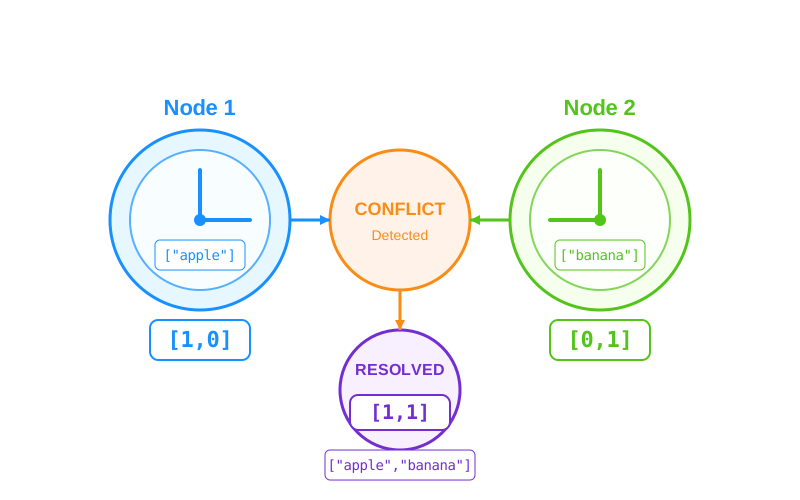
- User1 adds "apple" through Node1
- User2 adds "banana" through Node2 at the same time
After local updates:
Node1 has:
{
  "cart_id": "Cart#123",
  "items": ["apple"],
  "vector_clock": {
    "Node1": 1,
    "Node2": 0
  }
}
Node2 has:
{
  "cart_id": "Cart#123",
  "items": ["banana"],
  "vector_clock": {
    "Node1": 0,
    "Node2": 1
  }
}
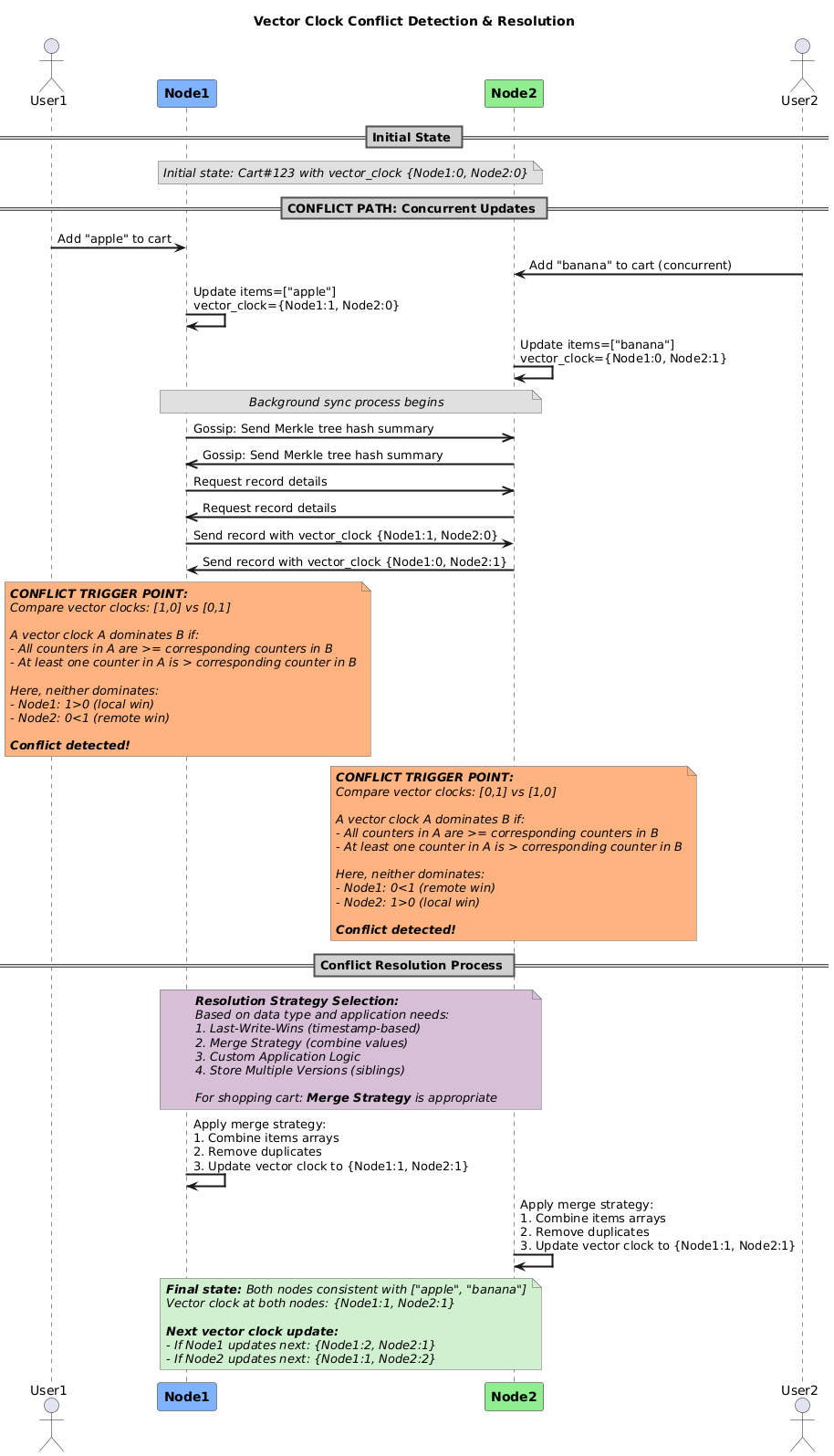
During synchronization, the nodes exchange their records and vector clocks. Comparing [1,0] vs [0,1], neither is fully greater or lesser. This is the hallmark of concurrent updates, and a conflict is correctly detected!
🧠 Conflict Resolution Strategies
Different systems employ various conflict resolution approaches:
| Strategy | How it works | When to use |
|---|---|---|
| Last-Write-Wins (LWW) | Pick the version with latest timestamp | When overwriting is acceptable |
| Merge Changes | Combine updates into a merged record | For additive data like shopping carts |
| Store Siblings | Keep both versions; resolve manually later | When preserving all data is critical |
For our shopping cart example, merging makes perfect sense. After resolution:
{
  "cart_id": "Cart#123",
  "items": ["apple", "banana"],
  "vector_clock": {
    "Node1": 1,
    "Node2": 1
  }
}
🔄 Behind the Scenes: How Sync Actually Works
The synchronization between nodes isn't a brute-force process, it's remarkably efficient:
- Lightweight fingerprint comparison: Nodes exchange hash trees (Merkle Trees) that summarize their data
- Detect mismatches: Differing hashes identify specific records that need synchronization
- Full data transfer: Only for mismatched records, nodes send:
- Complete record data
- Full vector clock metadata
- Compare vector clocks:
- If one version is newer → update
- If concurrent → detect conflict
- Resolve: Merge or pick winner based on conflict resolution policy
This process, called Anti-Entropy Repair, ensures that inconsistent nodes gradually converge to a consistent state.
📚 Key Terminology
| Concept | Meaning |
|---|---|
| Gossip Protocol | Nodes exchange information randomly and frequently |
| Anti-Entropy Repair | Nodes detect and fix inconsistencies through sync |
| Vector Clock | Metadata per record tracking causal history |
| Siblings | Multiple conflicting versions kept temporarily |
🎯 Key Takeaways
- Each record carries its own vector clock, not the server
- Conflicts are detected by comparing vector clocks during background syncs
- Conflict resolution depends on application needs: merge, overwrite, or ask the user
- Efficiency is achieved using Merkle Trees and fingerprints before sending full records
Distributed systems aren't about avoiding conflicts. They're about detecting conflicts correctly and resolving them based on your application's needs.
When to Use Vector Clocks
| If You Need | Consider | Why |
|---|---|---|
| Precise concurrent update detection | Vector Clocks | Full causality tracking, detects all conflicts with no false positives |
| Simple event ordering (single source) | Lamport Timestamps | Lightweight, sufficient when you only need "happened-before" ordering |
| Bounded clock skew with physical time | Hybrid Logical Clocks (HLC) | Combines physical and logical time. Used in CockroachDB and MongoDB. |
#SystemDesign #DistributedDatabases #NoSQL #DynamoDB #Cassandra #Riak #Engineering #DataConsistency #VectorClocks