CockroachDB vs Google Spanner: A Deep Dive Beyond the Basics
Global distributed systems need strong consistency and fault tolerance. Here's how CockroachDB and Google Spanner solve this differently.
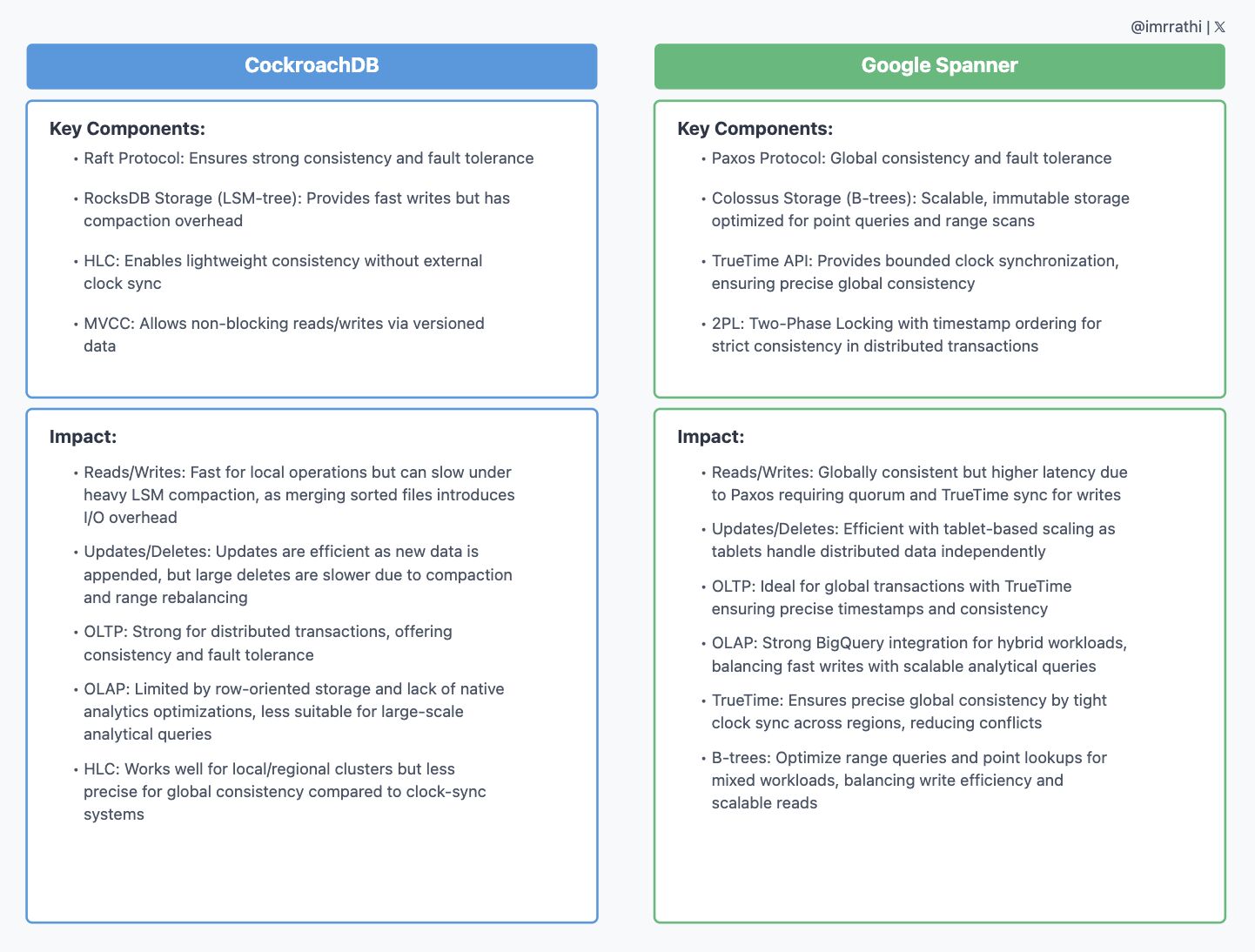
Here's a quick visual summary before the detailed comparison:
🌍 1. Deployment Flexibility
- CockroachDB can run virtually anywhere, on-prem, multi-cloud, or even locally in dev environments. This makes it highly versatile for startups and enterprises alike.
- Google Spanner is tightly integrated into Google Cloud. It requires you to be on GCP.
🧠 Need hybrid cloud or on-prem support? CockroachDB has the edge.
🔁 2. Schema Evolution & Indexing
- CockroachDB supports online schema migrations, partial indexes, and even inverted indexes, which are great for JSON-based workloads.
- Spanner also allows schema changes, but does so conservatively to maintain global consistency.
🧠 For rapidly evolving applications with complex data access patterns, CockroachDB offers more developer-friendly tools.
🔒 3. Consistency and Clock Synchronization
- Spanner uses the TrueTime API, which is built on atomic clocks and GPS to offer guaranteed bounded staleness.
- CockroachDB uses Hybrid Logical Clocks (HLC), a smart software-based solution that avoids reliance on external clocks.
🧠 TrueTime is unbeatable for global consistency, but it requires specialized hardware that only Google can offer. HLC is a clever workaround for everyone else.
📊 4. OLTP vs OLAP Workloads
- Spanner excels in hybrid workloads when paired with BigQuery, offering near real-time analytics at scale.
- CockroachDB, while solid for OLTP, is not optimized for analytical queries at massive scale, though it's improving rapidly.
💸 5. Cost & Accessibility
- CockroachDB offers a free tier, and you can run a single-node setup locally or in CI pipelines.
- Spanner is enterprise-grade, and so is the pricing. It shines in massive-scale, global-use cases, but might be overkill for smaller projects.
🧠 When to Choose What?
| Use Case | CockroachDB ✅ | Google Spanner ✅ |
|---|---|---|
| Multi-cloud or on-prem deployment | ✅ Fully supported | ❌ GCP only |
| Need for PostgreSQL compatibility | ✅ Works out of the box | ❌ Custom SQL dialect |
| Global, strong consistency | ✅ (HLC + Raft) | ✅✅ (TrueTime + Paxos) |
| Analytical processing at scale | ❌ Basic OLAP support | ✅ Strong BigQuery integration |
| Budget-sensitive deployments | ✅ Free and flexible | ❌ Enterprise-only |
💬 Final Thoughts
Whether you're building a global SaaS platform, a fintech backend, or a multi-region gaming app, both databases bring serious innovation to the table.
- Want Google-grade infrastructure without being locked into GCP? CockroachDB is a solid bet.
- Building at scale on Google Cloud? Spanner offers unmatched consistency and performance.
Explore the Technologies
Dive deeper into the technologies discussed in this comparison:
Core Technologies
| Technology | Role in This Comparison | Learn More |
|---|---|---|
| CockroachDB | Open-source distributed SQL with Raft consensus and HLC | CockroachDB |
| Google Cloud Spanner | Google's globally consistent database with TrueTime and Paxos | Spanner |
| PostgreSQL | Wire protocol that CockroachDB is compatible with | PostgreSQL |
| TiDB | MySQL-compatible distributed HTAP database, another Spanner-inspired system | TiDB |
| DynamoDB | Fully managed NoSQL alternative for key-value workloads | DynamoDB |
Infrastructure Patterns
| Pattern | Relevance | Learn More |
|---|---|---|
| Replication & Consistency | Raft vs Paxos, strong consistency vs external consistency | Replication & Consistency |
| Database Sharding | Range-based sharding in both systems, split management | Database Sharding |